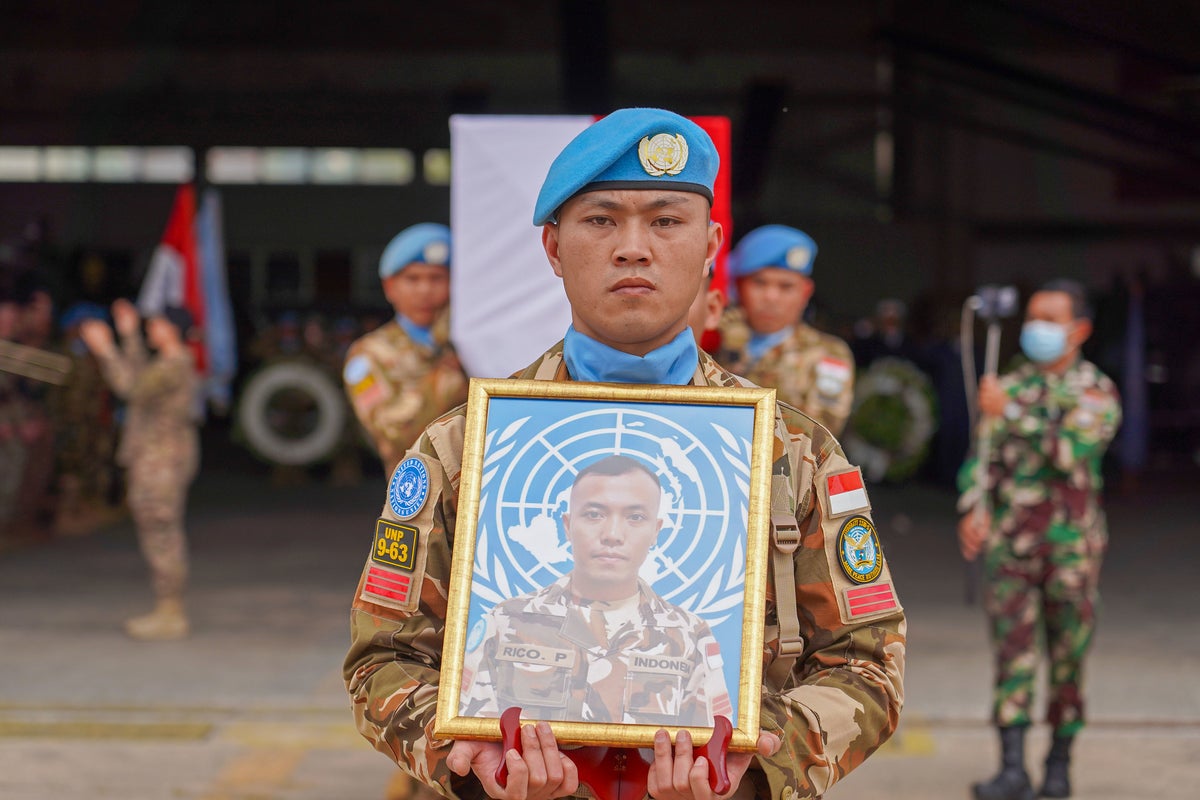
The United Nations Interim Force in Lebanon (Unifil) has been operating in a perilous environment, with seven peacekeepers killed since hostilities between Israel and Hezbollah reignited in early March. Four Indonesian peacekeepers were killed, two by an Israeli tank and two by an improvised explosive device (IED) thought to have been placed by Hezbollah. Two French peacekeepers were also killed in April by small arms fire in a likely Hezbollah ambush, and the latest fatality was a Serbian peacekeeper killed in June by a shell explosion of unknown origin.
Due to the dangerous conditions, Unifil peacekeepers no longer patrol far from their bases and do not conduct weapon searches as they used to. Their role is now limited to keeping a record of the conflict and protecting themselves. Unifil spokesperson Kandice Ardiel stated that ‘the mandate that we have persists, but obviously the situation around us has changed drastically.’ Before the recent escalation, Unifil had ‘fairly wide-ranging patrols within each contingent’s area of operations to look for unauthorized weapons and to monitor the situation.’ However, Ardiel explained that ‘we’re not able to do that anymore…
It’s just too dangerous to have peacekeepers out there when there’s active combat, when there’s projectiles being launched back and forth.’ Unifil was first deployed in 1978 following the Israeli invasion of Lebanon during its sectarian civil war. Since Hezbollah and Israel’s month-long conflict in 2006, its mission has been to uphold Resolution 1701, ensuring the Israeli withdrawal from southern Lebanon and supporting Beirut’s authority over the region. Israel has long opposed Unifil’s presence in the region, claiming it failed to stop Hezbollah’s military buildup or create a deterrent.
The US ambassador to the UN, Dorothy Shea, said earlier this year that ‘the time has come for Unifil’s mission to end.’ The UN Security Council voted to extend Unifil’s mandate until December 31 this year, after which it will expire and Unifil will have completely withdrawn by the end of 2027. The consequences of Unifil’s withdrawal are unpredictable, and the decision has been criticized by western allies. The UK’s UN representative at the vote, James Kariuki, said the Council was not able to make an ‘evidence-based assessment’ of the impact of Unifil’s withdrawal.
The war has had a devastating impact on Lebanon, with over 4,300 people killed and at least 1.2 million people displaced. Israeli PM Benjamin Netanyahu said his country’s forces would remain in the area as long as Hezbollah remained a threat. A deal brokered by the US links Israel’s withdrawal from Lebanon to Hezbollah’s disarmament, something Hezbollah rejects.
Professor Fawaz Gerges of the London School of Economics believes that Israel’s attempts to stifle peacekeeper operations represent a long-term attempt to ‘create a mini-Gaza in southern Lebanon.’ He warns that pressuring the peacekeepers to remain in their bases or leave southern Lebanon entirely would allow Israel to act without accountability. Gerges also warns of the risk to Israel posed by losing Unifil’s stabilizing effect, saying that ‘the presence of Unifil forces played a major role in providing rough stability and prevented Hezbollah from acting openly and having a free presence in southern Lebanon.’ A lasting end to the conflict is being sought by Beirut, which would avoid the region suffering the same fate as Gaza. Lebanese President Joseph Aoun said earlier this week that Beirut would not cede ‘a single inch of territory’ and defended ongoing talks with Israel aimed at securing a long-term settlement.
Should negotiations not succeed, Gerges says the Lebanese government is also ‘desperately trying to find an alternative replacement force’ to Unifil, particularly through France. An effort to form a post-Unifil force led by former French foreign minister Jean-Yves Le Drian, now President Macron’s special envoy for Lebanon, has been gaining momentum since exploratory talks reportedly began in January. Prof Gerges believes that Israel may come to regret pushing so hard for the UN’s withdrawal from south Lebanon as the cycle of violence and destruction continues.
In October, Netanyahu will face crucial elections, the outcome of which will have huge ramifications for Lebanon and the wider Middle East.