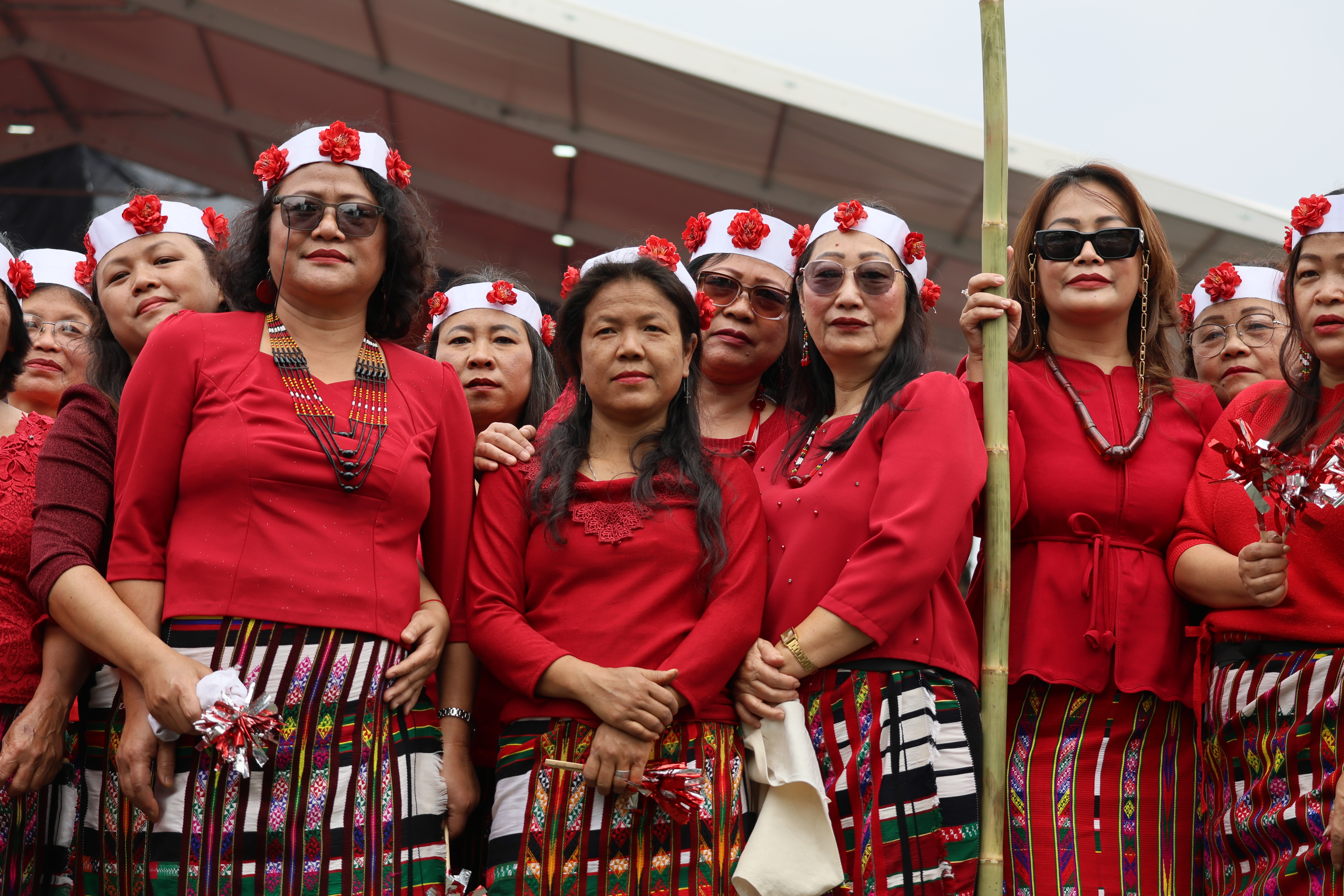
As the first bell of Sunday service echoes through the hills, the atmosphere in Mizoram shifts. The sounds of the week give way to a quieter rhythm. Across the city, women step out in handwoven puans paired with modest Sunday tops, making their way to church along narrow roads and steep lanes.
To an observer, this reflects continuity of culture and community life. At the same time, it raises questions about how tradition is practised and who carries its visible expressions. In many cases, women’s attire continues to reflect cultural expectations more strongly than men’s attire, which often features Western-style clothing.
In Mizoram, the church is a place of worship and also a public space where appearance can carry social meaning. Sundays become occasions where clothing is noticed and, at times, informally evaluated.
“The puan is beautiful, don’t get me wrong,” says Jessica (name changed), as she sits in her living room, the distant sound of hymns drifting through her window. “But there are mornings when the thought of the ‘gaze’ is too much. I’ve looked at my wardrobe, seen the Puan and the Sunday top, and felt a sudden, crushing weight. It’s not just fabric, it’s a uniform of performance.”
Jessica’s experience reflects a form of personal discomfort that has shaped her decisions over time. She recalls a specific Sunday when the pressure to perform ‘Mizo womanhood’ became difficult to manage.
“I stopped going to church around six or seven years ago, not because I lost my faith, but because of the expectation to wear Puan.”
However, Jessica’s story is not one of lost faith. “That doesn’t stop me from connecting to God,” she says. “I realised that my relationship with the divine isn’t just about me wearing Puan. I stayed home, prayed in my pyjamas, and felt a peace that the church aisle, with all its judging eyes, couldn’t give me.”
“The puan is unofficially everywhere. It’s what you’re expected to wear if you want to be seen as proper. But there’s no such expectation for men,” Jessica added.
For members of the LGBTQIA+ community in Mizoram, dress expectations in church can be complex. Clothing norms often align with binary ideas of gender, which may not reflect everyone’s identity.
“I identify as part of the LGBTQIA+ community,” says Liana (name changed). “To go to church, I have to perform a version of ‘woman’ that feels like a lie. If I wear a Puan, I feel like I’m in a costume. If I wear trousers and a shirt, I am seen as a rebel, or worse, a person of ‘loose character.’ You have to think so much before going to church because you have to either dress like a man or a woman, no matter if you are gay, lesbian, or trans.”
For some, this creates tension between participation in religious life and personal comfort.
As Sunday services conclude and people return home, the puan remains a visible part of cultural life. For some, wearing it is a meaningful choice. For others, it may feel more complicated.
At the same time, for some people who live outside of Mizoram, the puan continues to serve as a way of staying connected to their roots. Lalnunpuii, a resident of Washington, D.C., said, “Living away from Mizoram, there are not many ways to stay connected to our culture, so wearing the puan becomes one of the few ways to hold on to that connection. To me, it carries familiarity and memory. At the same time, I also understand that not everyone may feel the same way about it, and that choice is important.”
The ongoing question is how tradition can continue in ways that allow for both cultural continuity and individual choice.
Irene Lalnunpuii, the owner of a handloom company, Weave Me More Dreams, said, “While some feel the puan restricts movement, it remains a beautiful and meaningful part of Mizo identity. Even if not everyone knows how to wear it, it should never be forced. Encouragement, not compulsion, is what truly sustains culture. Instead of making it mandatory in churches, committees, or public spaces, we should remind Mizo women that when they wear the puan, they look their most beautiful and proudly uphold the culture of Mizoram, so that people choose it joyfully.”
She also shared how, from a handloom perspective, the puan represents one of the few unique indigenous industries in Mizoram. “When a puan woven by a Mizo woman is worn, it directly supports local livelihoods and strengthens the economy. Despite its cost, many choose to buy it because they know they are supporting fellow Mizo women, women who weave from their homes, care for their children, and sustain their families through this craft. In that sense, the puan is identity and economic empowerment woven together,” she said.
Source: EastMojo