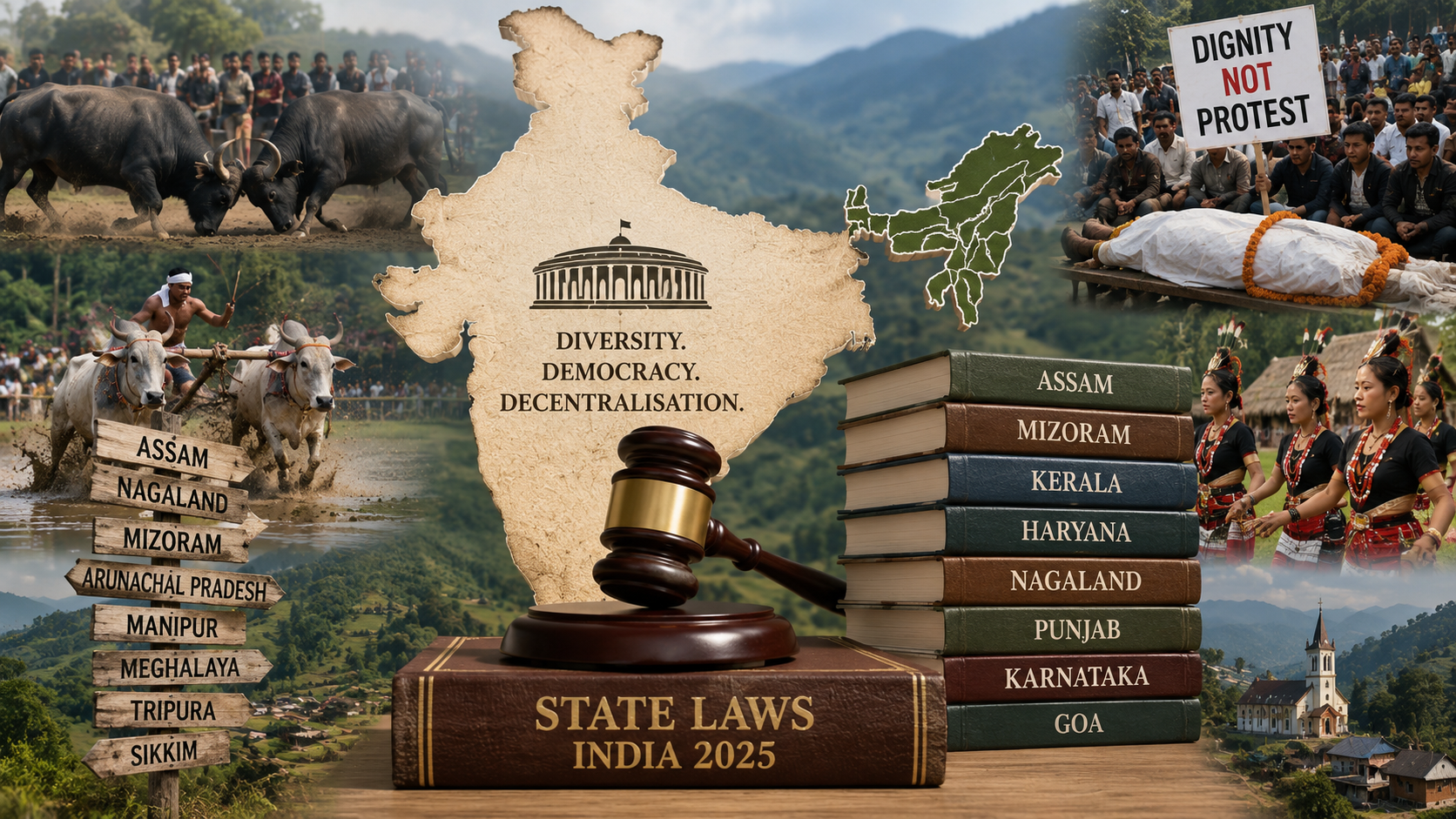
Somewhere in Assam, buffaloes can legally lock horns again. In Kerala, cattle can race down muddy tracks with official permission. In Mizoram, begging has been outlawed. And in Haryana, politicians can no longer use dead bodies as instruments of protest.
While Parliament often dominates the national conversation, India’s state legislatures spent 2025 quietly producing a remarkable collection of laws that reveal the country’s diversity, contradictions and political priorities in equal measure.
The Annual Review of State Laws 2025 by PRS Legislative Research shows that while state legislatures passed more than 600 bills last year, some of the most memorable dealt with local customs, social behaviour and uniquely regional concerns.
Nowhere was this more evident than in the Northeast.
Assam emerged as one of the most active legislative laboratories in the country. The state amended animal cruelty laws to permit traditional buffalo fights, a centuries-old spectacle that supporters regard as an important part of Assamese cultural heritage. Animal rights groups have long opposed the practice, but the legislation effectively restores legal protection to the contests.
At the same time, Assam moved in the opposite direction on social reform. It passed one of the country’s toughest anti-polygamy laws, prohibiting multiple marriages for all communities except Scheduled Tribes and residents of autonomous district areas.
A first offence can attract imprisonment of up to seven years, along with compensation for affected women.
The state also established district-level police accountability authorities to examine complaints against police personnel, created new land tribunals to deal with encroachments and disputes in tribal belts, introduced regulations for private coaching centres, and prohibited activities linked to religious conversion within certain universities.
In neighbouring Nagaland, lawmakers looked not to modern institutions but to traditional ones.
The state amended a colonial-era law to create a three-tier structure of customary courts that will adjudicate disputes according to tribal customs and practices. For many communities, the move formalises a justice system that has operated informally for generations.
Mizoram, meanwhile, took an unusually firm approach to public order. The state passed legislation prohibiting beggary, a measure officials say is intended to preserve social welfare and public discipline.
It also enacted laws establishing an ombudsman for local bodies, overhauled village council administration, and introduced a new framework for urban and regional planning.
Across the region, lawmakers also focused on identity and governance. Assam expanded the representation of several autonomous councils and created a new autonomous council for Karbi communities living outside the Karbi Anglong Autonomous Council area.
The legislation reflects the continuing importance of ethnic representation in Northeast politics.
Beyond the Northeast, states produced an equally eclectic collection of laws.
In Haryana, legislators passed a law to ensure the dignified disposal of the dead. Among its provisions is a prohibition on using dead bodies during protests.
Violators can face imprisonment ranging from six months to five years and fines of up to ₹1 lakh. The law appears aimed at a growing practice in which grieving families bring bodies to government offices or public spaces to demand justice or compensation.
Kerala, where legislative innovation often takes distinctive forms, authorised cattle racing under official supervision and prior permission from district authorities.
The state also enacted a law making Malayalam the sole official language for administrative purposes and introduced a right-to-public-services framework guaranteeing citizens time-bound delivery of government services.
Punjab chose to address religious sensitivities. A proposed anti-sacrilege law would impose penalties ranging from ten years’ imprisonment to life sentences for the desecration of holy scriptures.
The bill remains under legislative scrutiny but reflects the enduring political significance of faith-related issues in the state.
Karnataka tackled contemporary social tensions through a proposed hate-speech law carrying prison terms of up to seven years.
It also introduced a crowd-control bill requiring permissions for large public events and imposing penalties that can run into crores of rupees for violations.
Goa’s lawmakers turned their attention to animals of another kind. A new law prohibits the breeding, import and ownership of dangerous animal breeds considered a threat to public safety. Owners may also be held financially liable for injuries caused by their animals.
Some laws appeared almost tailor-made for local realities.
Himachal Pradesh criminalised interference with public utilities such as village paths, roads and canals. Bihar created a regulatory framework for livestock breeding and artificial insemination.
Gujarat established an authority to oversee bovine breeding and regulate semen banks. Maharashtra amended prison laws to create categories such as open prisons and special facilities for young offenders.
Together, these laws offer a reminder that the real diversity of Indian governance is often found not in Parliament but in the state capitals.
One legislature was debating buffalo fights. Another was regulating dangerous pets. A third was outlawing polygamy. A fourth was deciding how dead bodies could—or could not—be used in public protests.
In a country as vast and varied as India, lawmaking remains intensely local. The result is a legislative landscape that is often serious, sometimes surprising, and occasionally extraordinary.
If Parliament tells us where India is headed, state legislatures often reveal what India actually is: a mosaic of cultures, concerns and priorities, each finding expression through its own laws.
Source: EastMojo